What to do with old negatives (and how to decide)
Not sure what to do with old negatives? How to sort a shoebox, spot film that needs care, scan the keepers, store them safely and dispose of the rest.
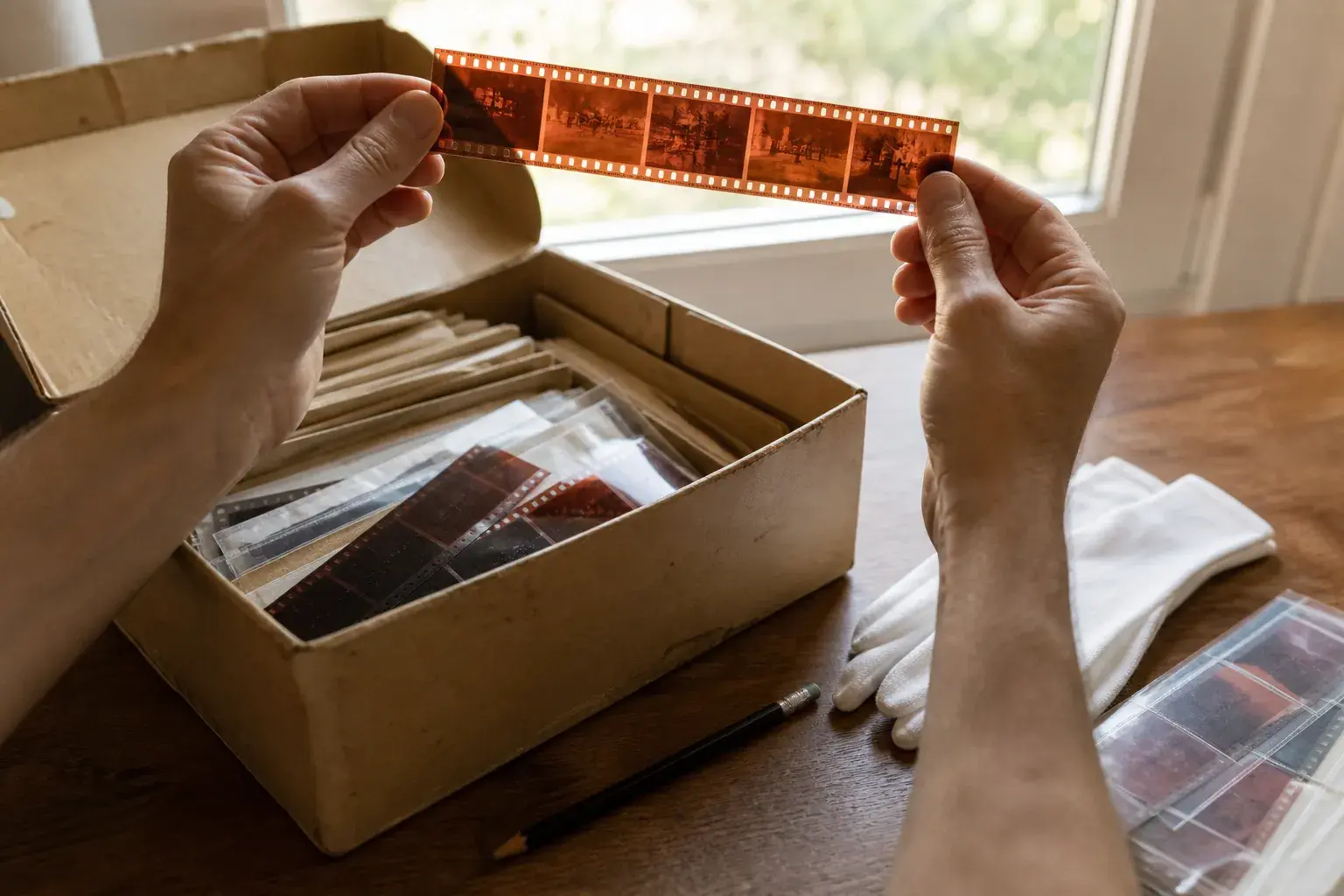
If you are wondering what to do with old negatives, the short answer is: look at them before you decide anything, scan the ones that matter, store the keepers in a cool, dry place, and only throw away what you have already scanned and truly do not want. Never burn them. Negatives are the originals of your family photos, and they often hold more than the prints in the album.
That still leaves a box of brown envelopes and a lot of questions. Are they worth keeping if you already have the prints? Is that vinegar smell a problem? Can you put them in the recycling bin? This guide answers each one in the order you will meet them: what is in the box, which film needs care right away, how to decide what to keep, a weekend plan to get through a shoebox, how to store what stays, and how to dispose of the rest safely and privately.
First, find out what is in the box
Most family boxes hold a mix of things that look alike but need different treatment. Take everything out onto a clean table and sort it into piles.
| What you find | What it is | What to do |
|---|---|---|
| Strips of orange or brown film, usually 4 to 6 pictures long | Color negatives (most common from the 1970s on) | Look, scan the keepers, store |
| Strips of gray film where light and dark are reversed | Black and white negatives | Look, scan the keepers, store |
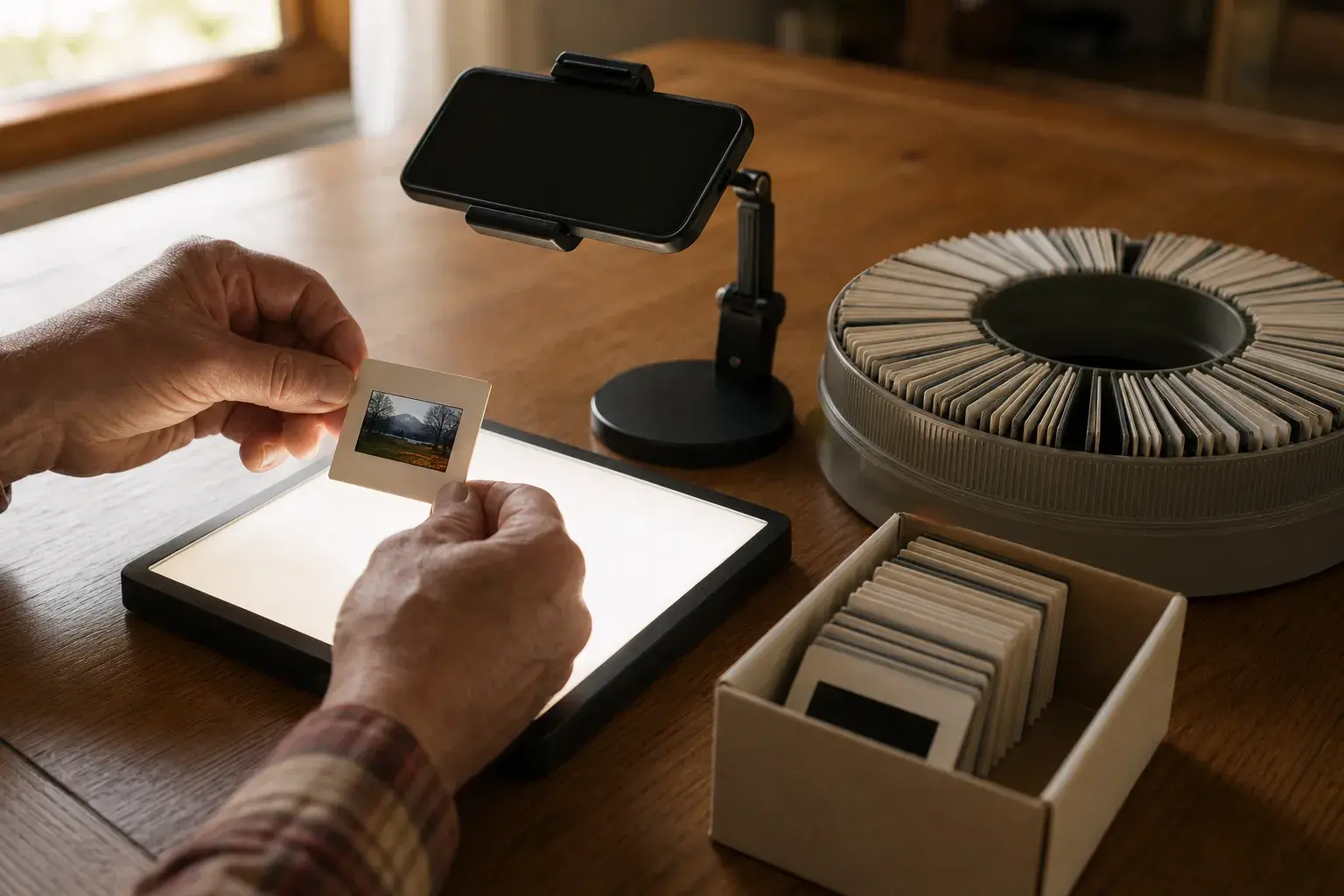
| Single pictures in white or gray cardboard or plastic frames | Slides (positive film) | See our guide to digitizing slides at home |
| Small plastic canisters or cartridges with film inside | Undeveloped film or a roll that was never collected | Do not open it in daylight; ask a photo lab that handles old film |
| Film that is wavy, sticky, powdery or smells of vinegar | Deteriorating film | Separate it now (see below) |
| Large single sheets of film, or film older than about 1950 | Possibly nitrate film | Handle with care (see below) |
A few clues help you put dates on things. Lab envelopes often carry a printed date or a store name. Many films have the manufacturer's name and frame numbers printed along the edge. Strips are usually cut in the order the pictures were taken, so a strip that starts with a birthday cake and ends at the beach tells you a story already.
Two kinds of film that need care right away
Most negatives from the 1950s onward are stable "safety" film and just need a dry, cool home. Two exceptions are worth checking for before you do anything else.
Film that smells of vinegar
Open each envelope and sniff. A sour, vinegar smell means the plastic base of the film is breaking down. The Library of Congress describes this as a self-accelerating decay of acetate film that leads to brittleness, shrinkage and, in the end, total loss of the image. Signs to look for: a vinegar smell, strips that curl or ripple and will not lie flat, white powder or crystals on the film, and an image layer that has started to crack.
What to do: put these negatives in a separate open box away from the rest (the acid they give off speeds up decay in nearby film), scan the ones you care about first, and keep them somewhere cool. Do not seal them in an airtight plastic bag at room temperature.
Very old film: check for nitrate
Before about 1950, much of the film used in cameras had a cellulose nitrate base. The National Park Service's film history timeline shows nitrate roll film from 1889, 35mm nitrate roll film made until 1938, and manufacturers printing "NITRATE" or "SAFETY" along the film edge from about 1930. It also notes that old stock was used up for years after production stopped.
Nitrate matters because it is a fire hazard. The Library of Congress warns that nitrate film is highly flammable, can ignite on its own at temperatures around 100°F (38°C) and cannot be put out once it is burning.
What to do: look along the edge of any film from your grandparents' era. "SAFETY" means it is not nitrate. "NITRATE", or no marking at all on film from before the 1950s, means treat it with care: keep it away from heat, sunlight and the rest of your collection, never store it in a hot attic, never burn it, and contact a local archive, museum or historical society for advice. The Library of Congress suggests digitizing nitrate film and then disposing of it properly, which is exactly what most families should do with it.
Are old negatives worth keeping if you have the prints?
Usually, yes, at least until you have looked at them. The negative is the original; the print is a copy made from it, decades ago, often in a hurry by a machine.
- Prints show less than the negative. Prints usually trim the edges of the frame, and a quick machine print rarely made the most of what was on the film. A careful scan of the negative often reveals detail in faces, shadows and skies that the print never showed.
- Prints fade and shift faster. Color prints that spent 40 years in an album or a frame are often yellowed, pink or washed out. The negatives, kept in the dark in a box, have usually held up better.
- You may not have every print. Some frames were never printed because they looked too dark, prints went to relatives or were lost in a move. The negatives are often the only complete record of a roll.
- Negatives can be scanned again. Scanning tools keep getting better. A negative you keep can be scanned again in ten years; a print you threw away cannot be rebuilt from a small scan.
If the negatives and the prints match, the prints are in good shape and nobody in the family will want them, keeping only the best ones is a fair choice. Just make that decision after scanning, not before.
How to decide: keep, scan, print, give away or dispose
Go strip by strip and ask what each one is worth to you and to your family. This table covers almost every case.
| The negatives show... | Suggested choice |
|---|---|
| People you love, family events, homes, pets | Scan, keep the negatives |
| Things nobody else has a photo of (a grandparent young, a house that is gone) | Scan carefully, keep, back up the scans twice |
| Blurry, black, blank or duplicate frames | Scan if in doubt, then dispose |
| Scenery and strangers from a trip nobody remembers | Scan a few for the story, dispose of the rest |
| Street scenes, shops, local events, old cars, a factory or farm at work | Scan, then ask a local historical society if they want the originals |
| Film that smells of vinegar or may be nitrate | Scan first, then follow the care advice above |
| Someone else's photos, or pictures that feel private | Ask the family first; if nobody wants them, dispose of them privately |
Two rules make this easier. First, scan before you throw anything away: a quick scan costs you a minute, a thrown-away negative is gone. Second, ask before you decide for others: brothers, sisters and cousins often care about pictures you would skip, and they may know who is in them.
A weekend plan for a shoebox of negatives
A typical shoebox holds somewhere between a few dozen and a few hundred strips. You do not need to do it all at once, but one focused weekend gets most families through the hardest part.
Saturday morning: sort and look (about 2 hours)
- Set up a clean table away from food and drinks. Wear cotton or nitrile gloves, or at least wash and dry your hands, and hold film only by its edges.
- Do the safety checks above: sniff for vinegar, look for nitrate markings on older film, and set aside anything that needs care.
- Keep each envelope with its strips. Write a number on the envelope in pencil and note what you know: year, place, who.
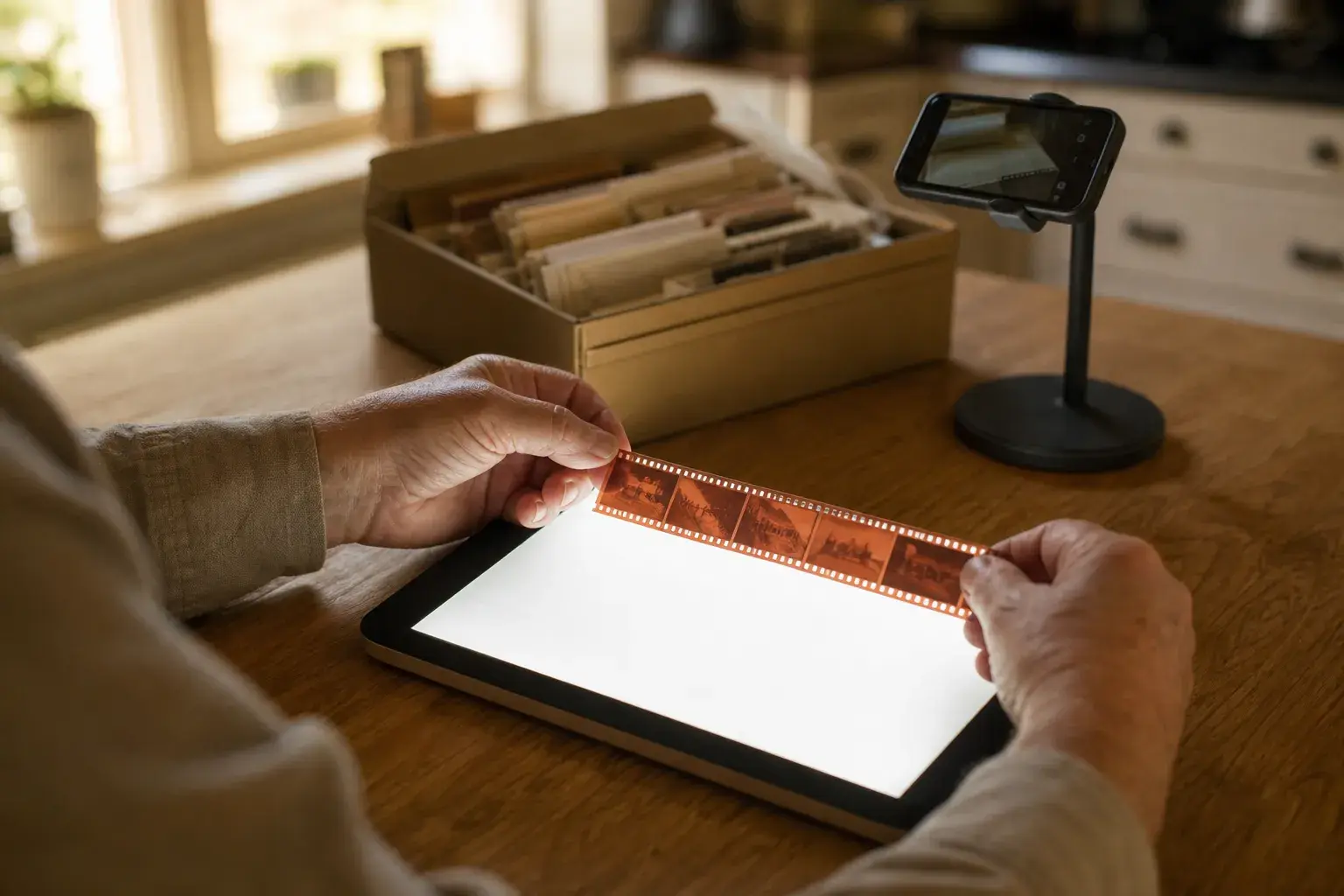
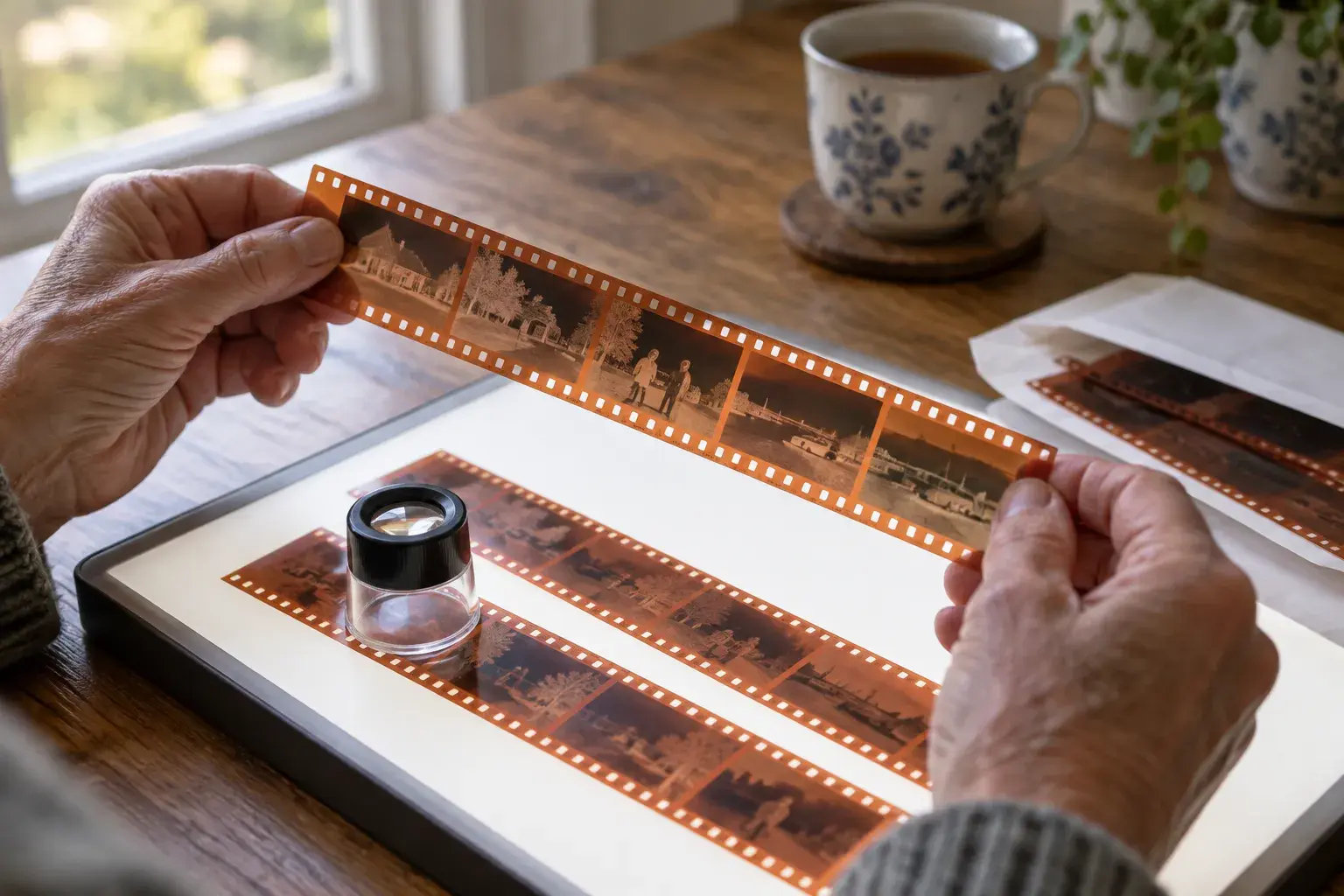
- Preview the strips. Negatives are hard to read by eye because light and dark are reversed. Hold a strip over a light pad or a white tablet screen and point your phone at it with Film Scanner open: the camera shows the converted positive while you aim, so you can see faces and scenes before you decide anything. Scanning is free.
Saturday afternoon: scan the keepers (2 to 4 hours)
Follow our step-by-step guide to scanning negatives with your phone for the light, the setup and the settings. In short: choose the right film profile (color or black and white negative), keep the phone steady and parallel to the film, and use Roll mode to shoot a whole strip or envelope in one go with the same look. Once your setup is in place, a strip of six frames takes a few minutes.
Sunday: name, back up and share (2 to 3 hours)
- Name the files with the year and the place, matching the envelope number ("1983 envelope 07 Grandma garden").
- Back up in two places, for example your photo library and an external drive or a cloud folder.
- Share with the family and ask for names and dates. A shared album often brings back stories nobody has told in years.
- Put the keepers away properly (next section), and only then deal with the rest.
How to store the negatives you keep
The Library of Congress gives clear guidance for film, and most of it is easy at home:
- Sleeves: use sleeves or envelopes made of polypropylene, polyethylene or archival paper that pass the Photographic Activity Test (PAT). Avoid old PVC pages that feel sticky or smell of plastic.
- Boxes: store sleeves upright or flat in a sturdy archival box. Remove rubber bands, paper clips and sticky notes.
- Climate: cool and dry, with a relative humidity between 30 and 50 percent. A closet in the living area is better than an attic, a garage or a basement, where temperature and damp swing through the year.
- Labels: write on the sleeve or box, never on the film, using a pencil or a pen made for archival use.
Old lab envelopes are fine for now, but their glue and paper can harm film over decades. Swap them for archival sleeves as you go, and keep the envelopes if they carry dates or notes.
How to dispose of old negatives safely
Once you have scanned what matters and asked the family, it is fine to let the rest go. Do it in a way that protects your privacy and the environment.
- Check once more. Make sure the scans are saved and backed up in two places.
- Protect privacy. Negatives can be scanned by anyone who finds them. Cut through each strip across the frames with scissors before you throw it away, especially for pictures of children, homes or documents.
- Check your local rules. In many places negatives go in household trash, not the recycling bin, because film is coated plastic that recycling plants cannot process. The City of Calgary, for example, tells residents to put photographs, film and negatives in the garbage. Some councils and institutions treat film as special waste because of the silver it can contain, so look up "photo negatives" on your local waste website.
- Never burn negatives. Burning plastic film gives off harmful smoke, and nitrate film burns fiercely and cannot be put out.
- Nitrate is a special case. Do not put film you think is nitrate in the household trash. Ask a local archive, museum or your waste authority how to dispose of it.
Giving negatives away
If the photos show a town, a business, a school or an event, a local historical society, library or archive may be glad to have them, especially with notes on who, where and when. Call first and ask: many collections are full and will only take material that fits what they keep. Keep your own scans either way.
Give the best photos a second life
The reason to do any of this is to see and share the pictures again. Once they are scanned:
- Print the favorites at a photo kiosk, an online print service or at home.
- Make a photo book for a birthday or an anniversary.
- Send a real postcard. In Film Scanner you can turn a scan into a 4 x 6 postcard that is printed and mailed for you, anywhere in the world (international delivery can take a few weeks).
- Restore the special ones. For badly faded, scratched or small photos, the Premium AI tools in the app can restore, colorize, upscale or animate a picture. Keep the plain scan as well.
Frequently asked questions
Are old negatives worth saving?
In most cases, yes. Negatives are the original record of your photos, they often show more than the prints, and they can be scanned again later. If you have limited space, scan everything first and keep the negatives of the pictures that matter most.
Can I throw away negatives after scanning them?
You can, once the scans are backed up in two places and nobody in the family wants the originals. Many people keep the negatives of their most precious photos and dispose of blurry, blank and duplicate frames. Cut through the frames first for privacy and check your local waste rules.
How do you dispose of old negatives?
In many places they go in household trash, not recycling, but rules differ, and some areas treat film as special waste. Cut through the frames for privacy and never burn them. Film that might be nitrate needs advice from your local archive or waste authority.
Are old negatives worth any money?
Family negatives rarely have resale value; their value is to your family. Negatives of historic local scenes or events may interest a historical society or archive, and work by a known photographer is a different matter that an archive or auction specialist can assess.
Can you still get photos from old negatives?
Yes. Developed negatives can be scanned at home with a phone, scanned by a lab, or printed by a lab that still offers printing from film. Undeveloped rolls are a different case: take them to a lab that develops old film.